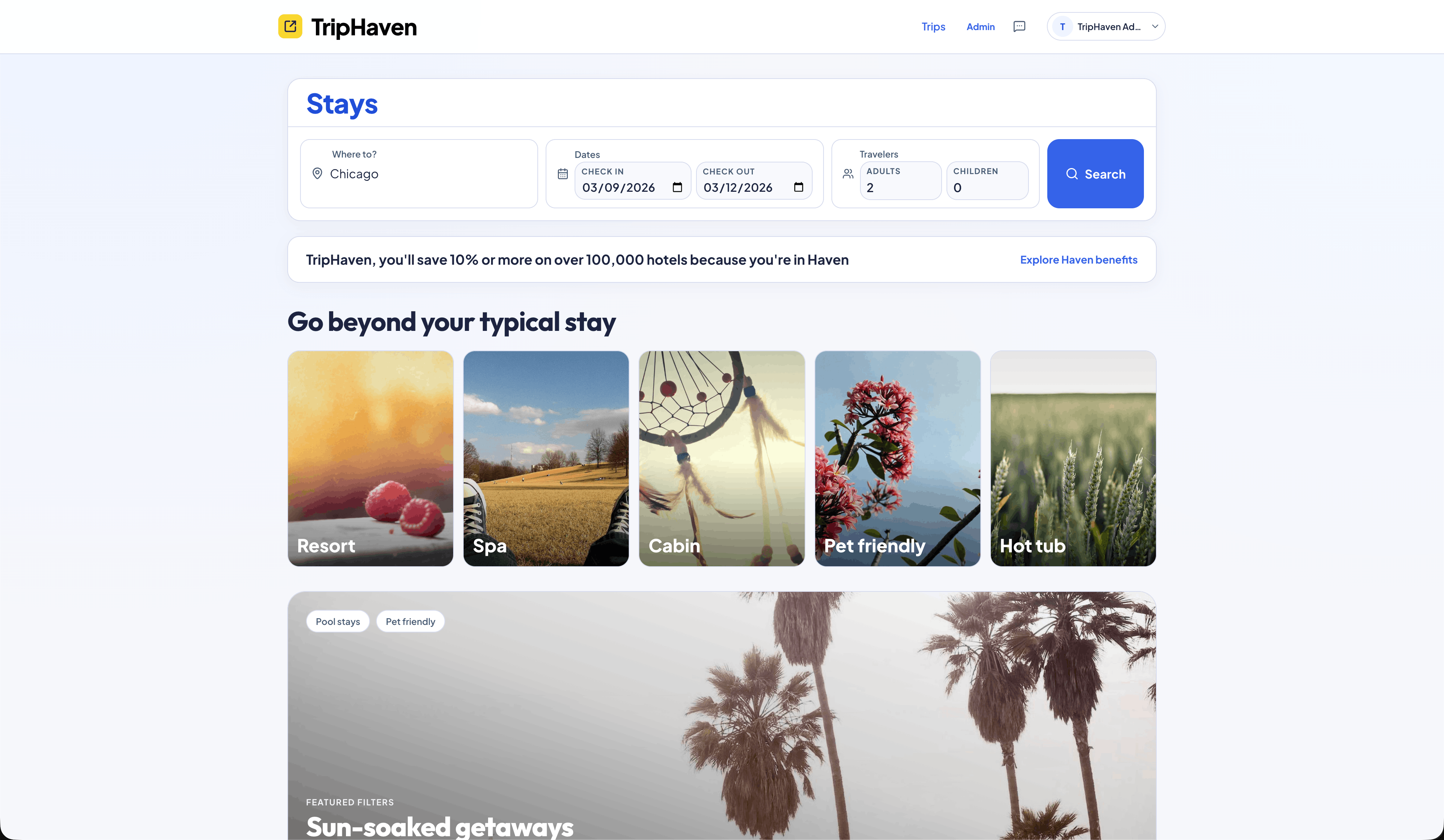
I just built TripHaven, a full-stack Expedia-style hotel booking platform, in about six hours.
That is not because the work is “easy.” It is because a skilled engineer with the right modern workflow can now scaffold serious prototypes much faster than interview loops usually assume.
What TripHaven is
TripHaven is a full-stack booking app with:
- Home search with destination autocomplete, date selection, and guest controls
- Faceted
/searchwith URL-driven state, sorting, filters, pagination, and map support - Hotel detail pages with galleries, amenities, policies, reviews, and room offers
- Auth-gated checkout and booking confirmation flows
- Saved listings and profile booking history management
- AI chat assistant with tool-calling and an MCP endpoint over the same hotel data layer
- Admin tools for listings, room/rate/inventory management, media, and review operations
Stack-wise, this build uses TanStack Start, tRPC, Better Auth, Drizzle ORM, Postgres, and TypeScript.
How this 6-hour spike actually worked
This is not something you can single-prompt into existence.
You have to be systematic.
I start from a scaffold of technologies I already know and trust, then iterate feature by feature with clear boundaries.
I also do not over-index on design at the start. With a strong technical foundation, I can pivot the design direction later without rewriting core flows.
Specs are part of the build, not a cleanup phase.
I add unit and end-to-end specs throughout implementation so regressions get caught while the system is still evolving.
Is this 6-hour spike missing functionality? Of course.
But the point was the process and technical decision-making that got it to a credible end-to-end state, not pretending it is production-ready on day one.
Why this matters for interviewing
Older technical loops often say: “Build feature X in a timed environment.”
That still measures something, but it misses how strong engineers actually ship now:
- They frame the product and scope tradeoffs
- They scaffold systems quickly with modern tools
- They verify generated code instead of blindly trusting it
- They make architecture calls under real constraints
- They communicate decisions clearly to stakeholders
So instead of “build one isolated feature,” a stronger interview format is:
Replicate a known app slice end to end, then present your implementation thoroughly:
- Why you chose the architecture you did
- Where you used AI and how you validated outputs
- What you cut, what you deferred, and why
- What breaks first in production and how you would harden it
That maps much closer to real engineering work than syntax recall under a timer.
The bar should move up, not down
This is not an argument for easier interviews.
It is an argument for better interviews:
- more systems thinking
- more product replication under constraints
- more accountability for correctness
- more communication around tradeoffs and reliability
If candidates can scaffold faster now, interview quality should increase by evaluating judgment and execution depth, not just keystrokes.
Related updates
- Project page: TripHaven
- Layoff log: Week 3: TripHaven prototype