
Carry the last fragment of a broken sun. You are a small brass automaton in a city of copper, glass, and failing machinery. Fight across upper galleries, surface works, and buried chambers; collect equipment and memories; then carry your embers to the next bellgate before the city claims them back. At the top waits the Brass Regent.
A city with depth
Every biome connects three elevations, from upper galleries to surface works to undercroft, through stairways, platforms, gaps, and drop shafts. Double-jump up into the galleries, drop through a ledge into the undercroft, and find connected routes back to the surface. A camera that follows on both axes, plus a full-height atlas, keeps track of the journey, and the layered backdrops change with both distance and elevation.
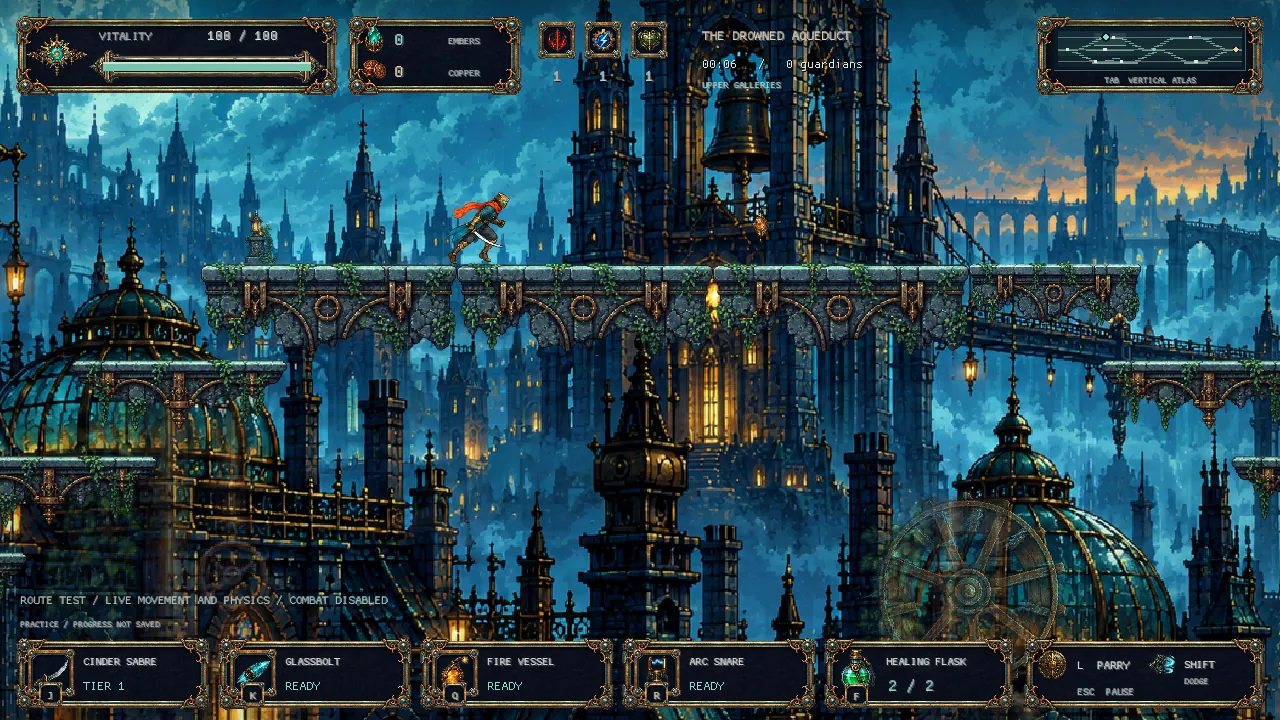
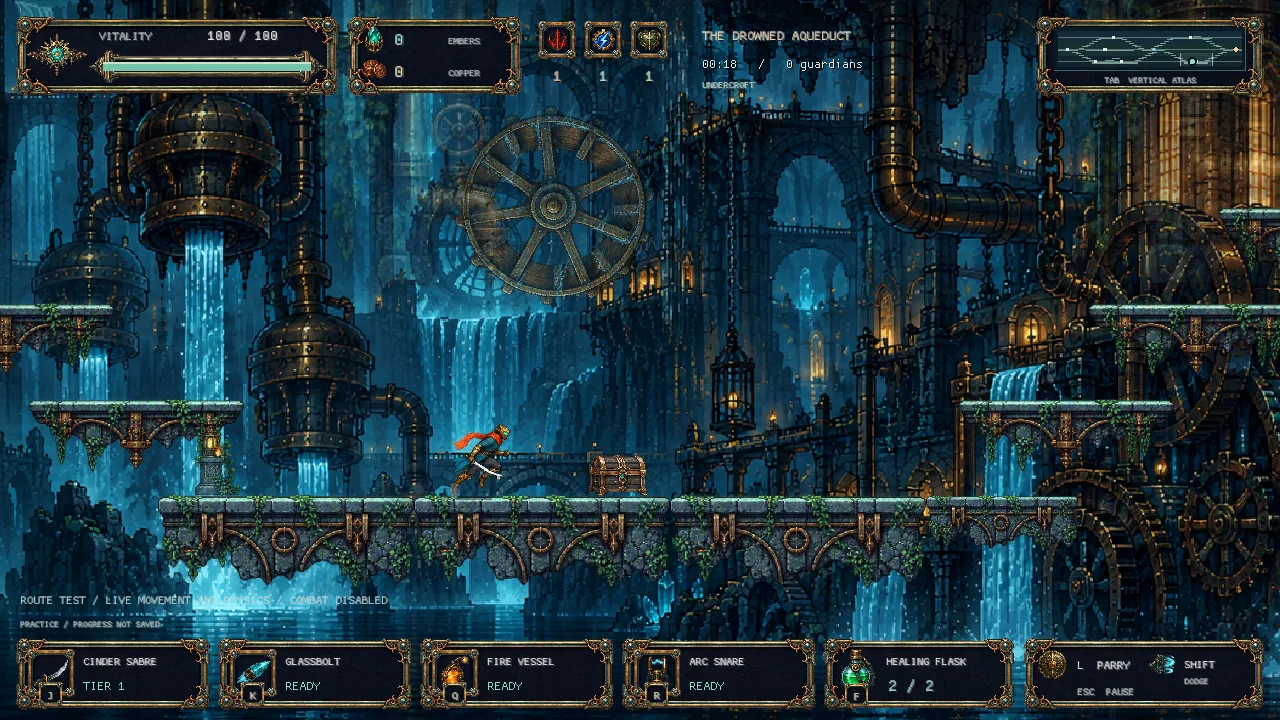
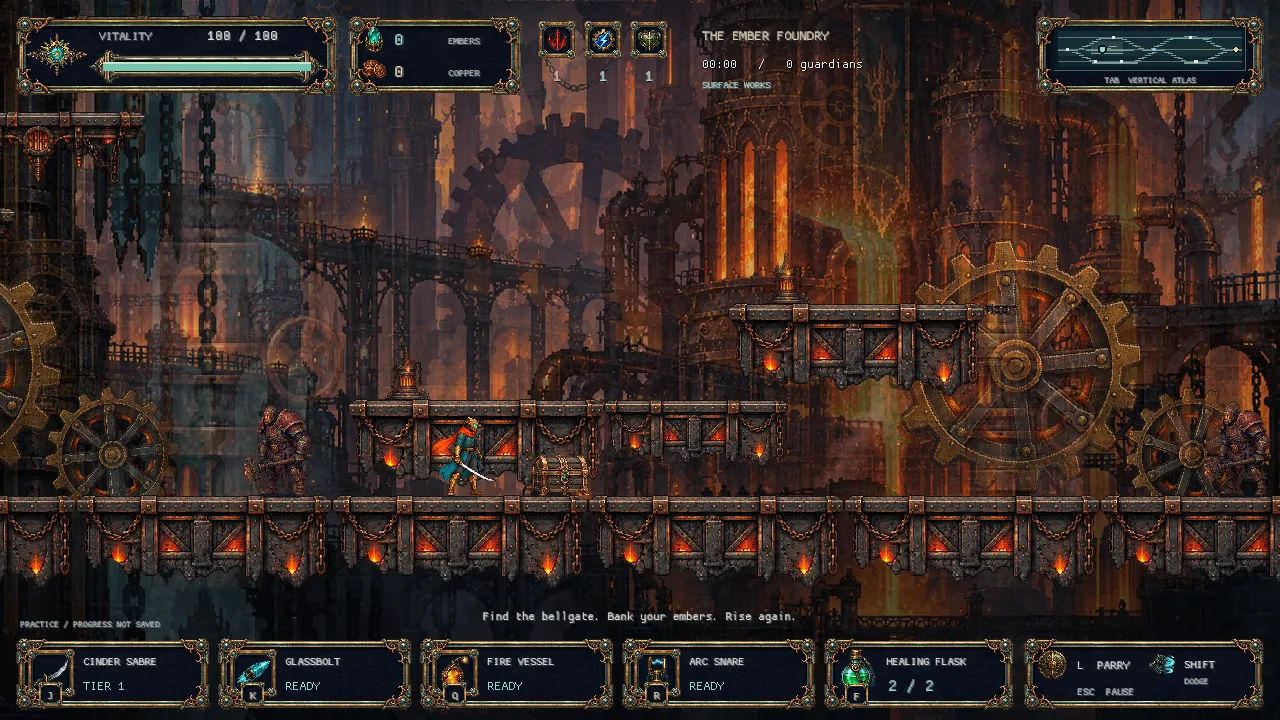
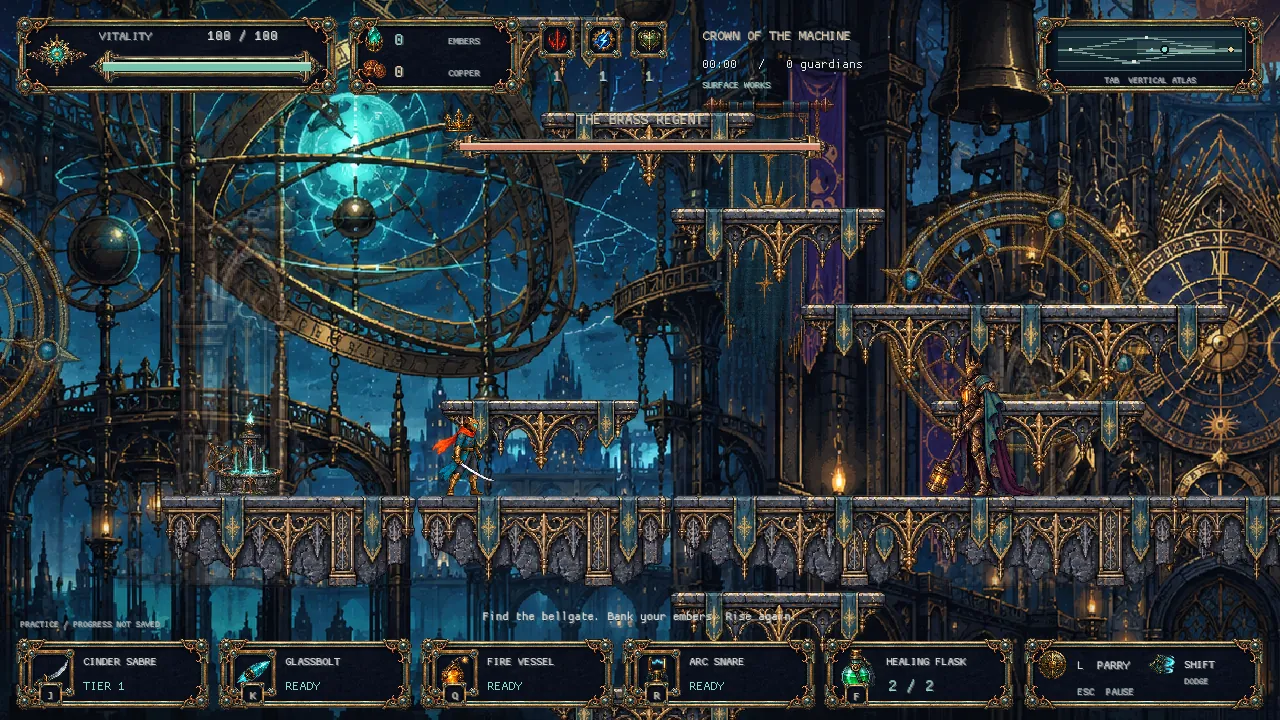
A run starts in the flooded galleries and waterwheels of the Drowned Aqueduct, then branches to either the Glassroot Conservatory or the Ember Foundry, before climbing to the Crown of the Machine and the Regent. The routes are authored, with seeded variation in enemies and rewards.
Responsive combat, choices that carry
Chain melee strikes, reflect projectiles with directional parries, dodge through danger, fire glassbolts, throw fire vessels, and place arc snares. Hit-stop, camera shake, dodge afterimages, and event-driven particles sell every impact.
Chests swap your melee weapon for an upgraded random one, memories raise one of three stats, and forges temper your weapon for copper. Carried embers are banked when you reach a bellgate, and at the Keeper’s rest you spend them on permanent vitality, flask capacity, or a mutation for the current run. Death resets your equipment and carried embers, but banked progress survives.

What it’s built with
Cinderwake is a custom game framework in Rust on top of Macroquad, which supplies the window, input, GPU drawing, and audio. Everything else is Cinderwake’s own code: the fixed-step simulation, platform physics, combat, enemy AI, progression, animation, rendering composition, and tools.
- Simulation runs at a fixed 120 Hz, independent of the render rate. Visual effects use their own random stream, so changing particle emission never changes gameplay randomness.
- Movement has acceleration, variable-height double jumps, coyote time, jump buffering, one-way platforms, deliberate drop-throughs, and an aerial ground slam.
- Rendering draws 640 × 360 world coordinates to a 1280 × 720 target with nearest-neighbour sampling, then applies separable selective bloom, per-biome color grading, a vignette, and up to eight dynamic combat lights, with an unfiltered fallback.
- Particles come from a bounded pool of 512: sparks, debris, smoke, dust, motes, shockwaves, and flashes.
- Saves are version-tolerant JSON written with atomic file replacement.
All runtime art, fonts, shaders, and audio are embedded in the executable.
How it was made
The setting, characters, and encounters are original. Dead Cells was the initial reference for genre and feel, but no Dead Cells assets or code are used. The artwork, including character sheets, environments, animated scenery, vertical backdrops, and interface elements, was generated with an AI image-generation tool, and the original outputs and prompts are kept in the repository. Code at runtime then extracts connected silhouettes from the sprite sheets and anchors the sprites. The ambience and nine sound effects are synthesized by a Python script.
Tests cover physics, combat, progression, animation timing, effects, and multi-biome traversal, including a route follower that drives normal input through every tier and checks each exit is reachable and returnable. CI runs tests, Clippy with warnings as errors, and a format check. The README notes that rendered captures are a separate visual check, and passing tests alone don’t prove visual quality.
Play it
Cinderwake is a playable prototype, verified on Apple Silicon Macs. There’s no release download. Install Rust, clone the repository, and run cargo run --release --locked, or build a local .app with ./scripts/package-macos.sh. Gamepad support, control rebinding, and broader progression aren’t implemented yet. The code and generated assets are MIT licensed.
Browse the source on GitHub. GitHub records the repository’s creation on October 4, 2026.