
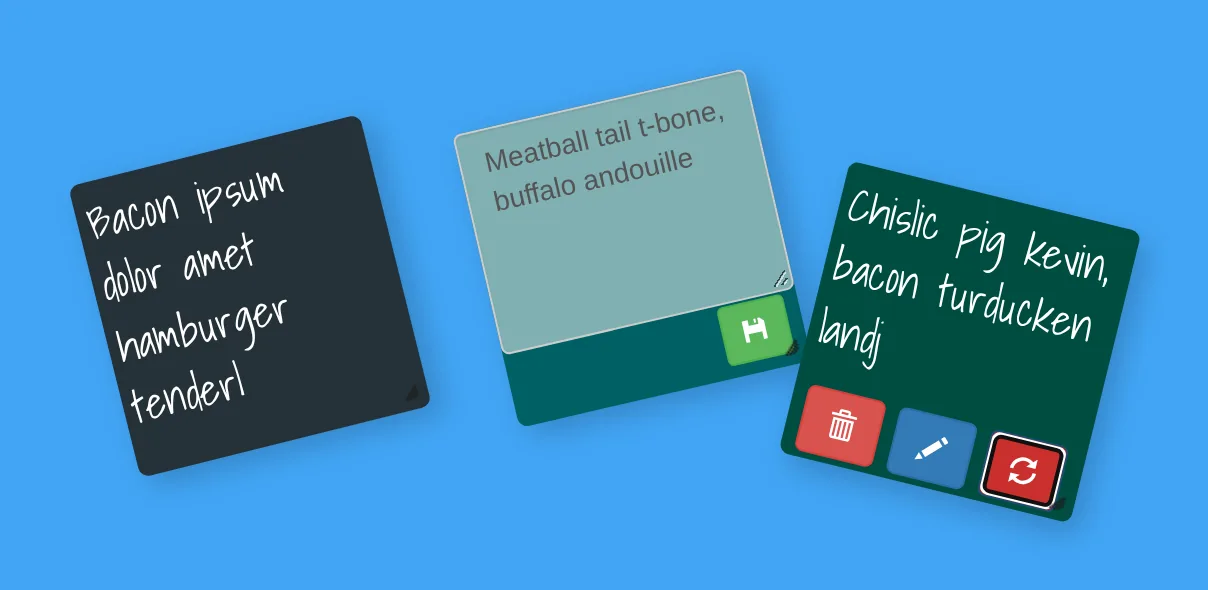
The repository is named for what it is: a first React app, a pin board built over four days in July 2015. The page, titled “React Bulletin Board”, fills a blue board with 20 sticky notes, each at a random spot with a slight tilt and one of eleven colors, in a handwritten font. You can drag notes around, resize them, edit or delete them with buttons that appear on hover, and add one reading “New Note” with the + button.
The notes’ text comes from the Bacon Ipsum API: the board asks for 20 sentences, splits them up and cuts each one to 40 characters. The README’s “new additions” were rotation and random colors. Each note has a rotate button that turns red when it’s on, and while it’s on, dragging the note also spins it, by as many degrees as it sits pixels from the left edge.
How it’s built
The app is three files: index.html, a stylesheet and js/Note.js. React 0.13.3 and its JSXTransformer load from Facebook’s fb.me links, and the transformer compiles the JSX in the browser. A Board component holds the list of notes and checks its count prop with a custom validator that warns when it isn’t a number or is over 300. Each Note is a React.createClass component that hands its DOM node to jQuery UI’s draggable and resizable, and Bootstrap 3 supplies the buttons and their icons.

Running it today
It still runs as it was. The fb.me links for React now redirect to unpkg, and the jQuery, jQuery UI, Bootstrap and Google Fonts links still answer. Serve the folder with any static web server: JSXTransformer fetches js/Note.js with an XHR, which the browser blocks when the page is opened as a file. The notes depend on Bacon Ipsum, which answered when these screenshots were taken on November 17, 2026 but was refusing connections later that day. Without it the board starts empty, though the + button still adds notes.
The creation date shown here is the GitHub repository’s UTC creation date. The screenshots were captured by running the project locally from its unmodified source, with note text from the live Bacon Ipsum API, and the code card shows the project’s own source.