
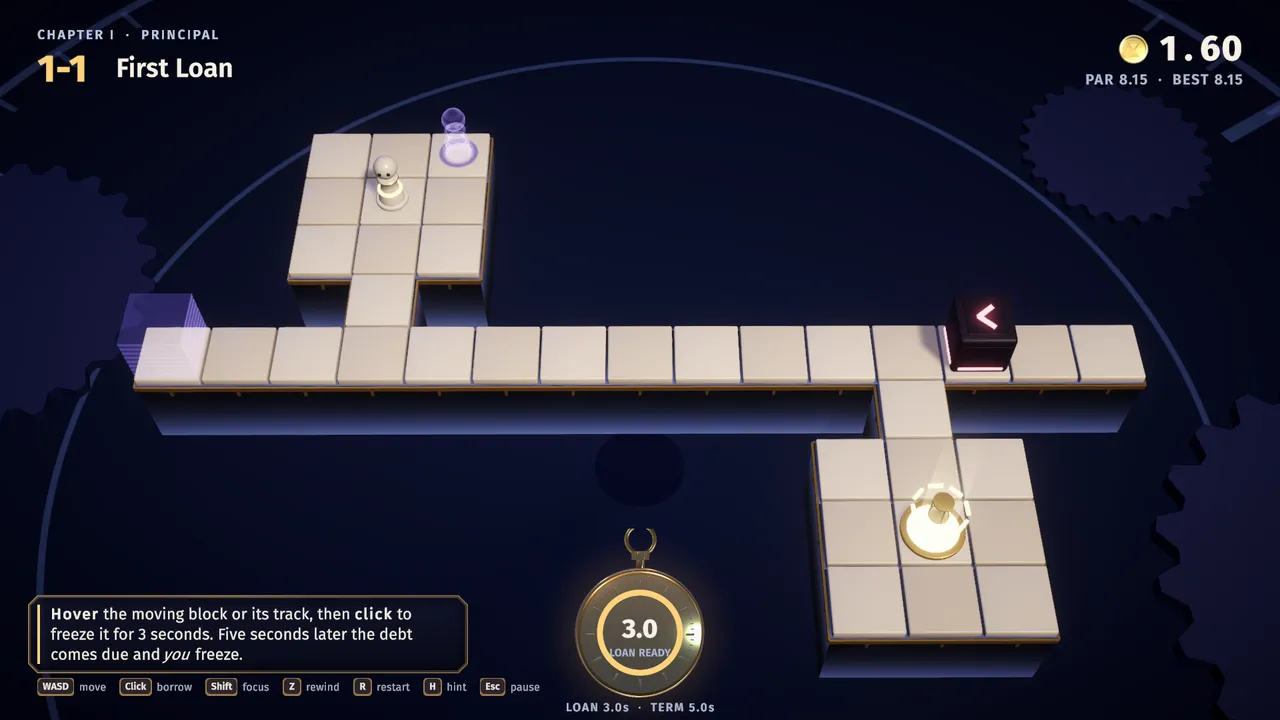
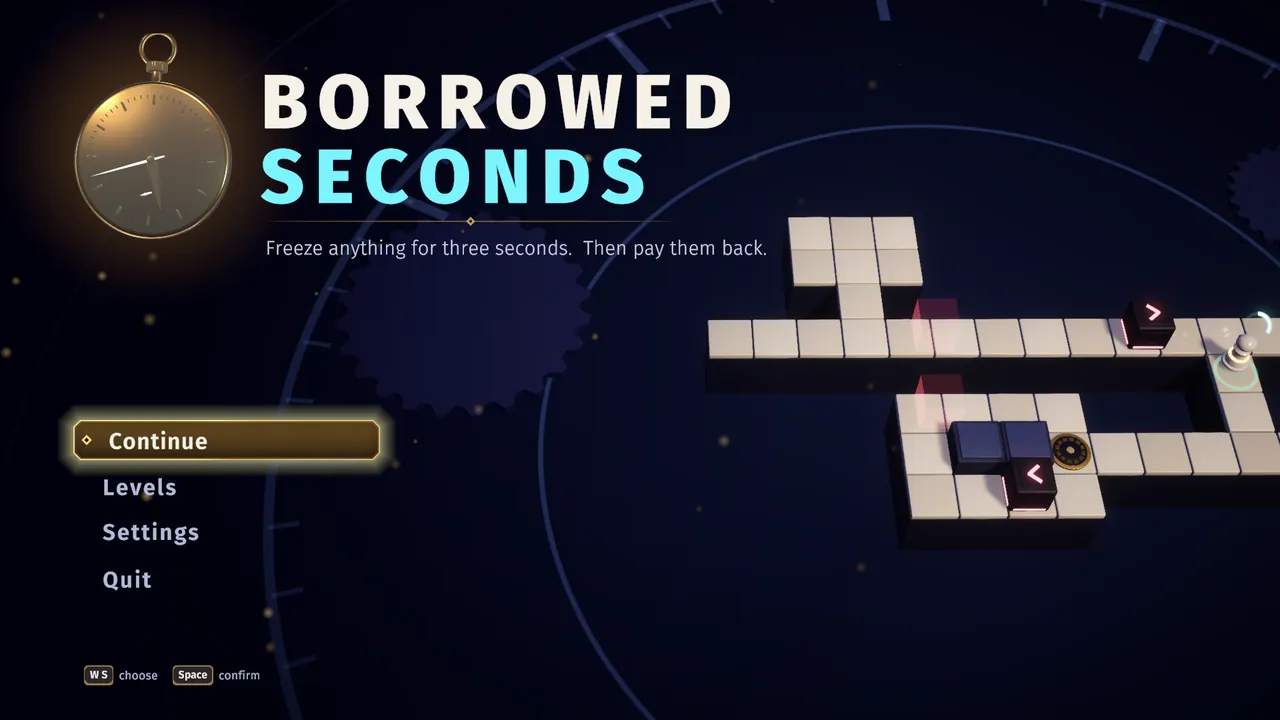
Freeze any moving obstacle for three seconds. The catch is that the time is borrowed. A few seconds later the debt comes due and you freeze for three seconds, wherever you happen to be standing.
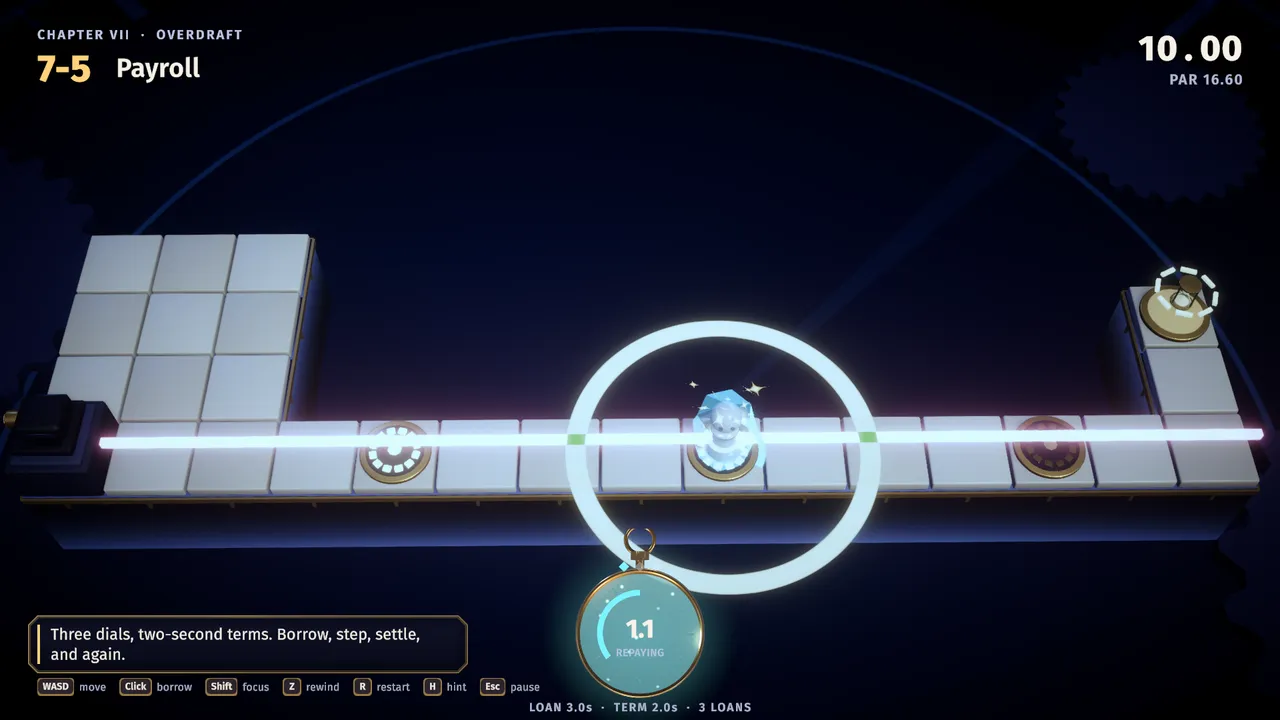
While you’re frozen, nothing can hurt you. Sliders, laser beams, and rotor arms pass straight through. But if you thaw inside a hazard, you default, and time rewinds. The best solutions turn the debt into the plan: you pay it back standing on a gold dial, or exactly as a laser sweeps over you.
One verb, two sides
Borrowing turns a sliding block, a laser, or a rotor arm into crystal for three seconds, and a frozen obstacle is a wall. Repaying freezes you, and a frozen player is untouchable. Both halves are useful.
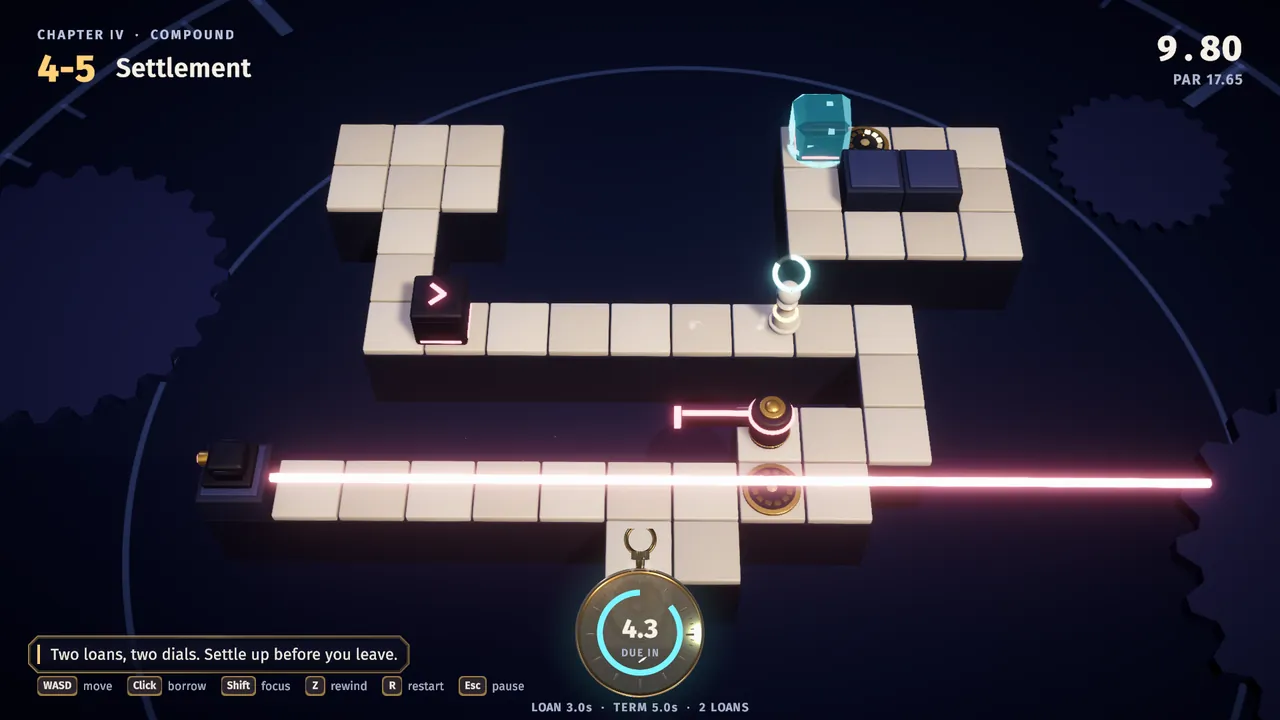
The game is honest about the future. Aim at something and red ghosts show where every hazard will be at the moment you’d thaw, along with a safe or lethal ring under your feet. They’re calculated by running the real simulation forward, so they’re never wrong, and the verdict never rests on colour alone: a lethal ring carries an X and the aim tag says SAFE or LETHAL. Each level waits at 0.00 until you first move, so you can read the board before anything moves. Hold Focus to slow time while you line up a shot, or hold rewind to scrub back through everything that happened. A default names what caught you and marks it in red.
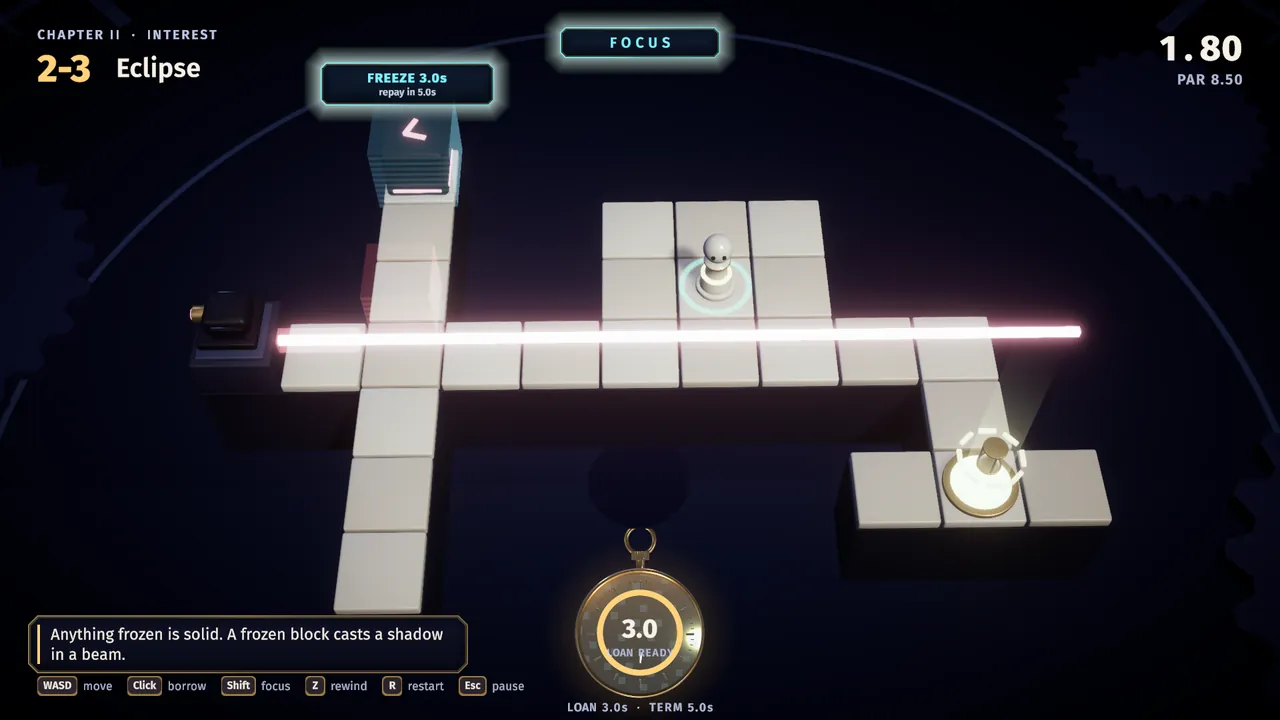
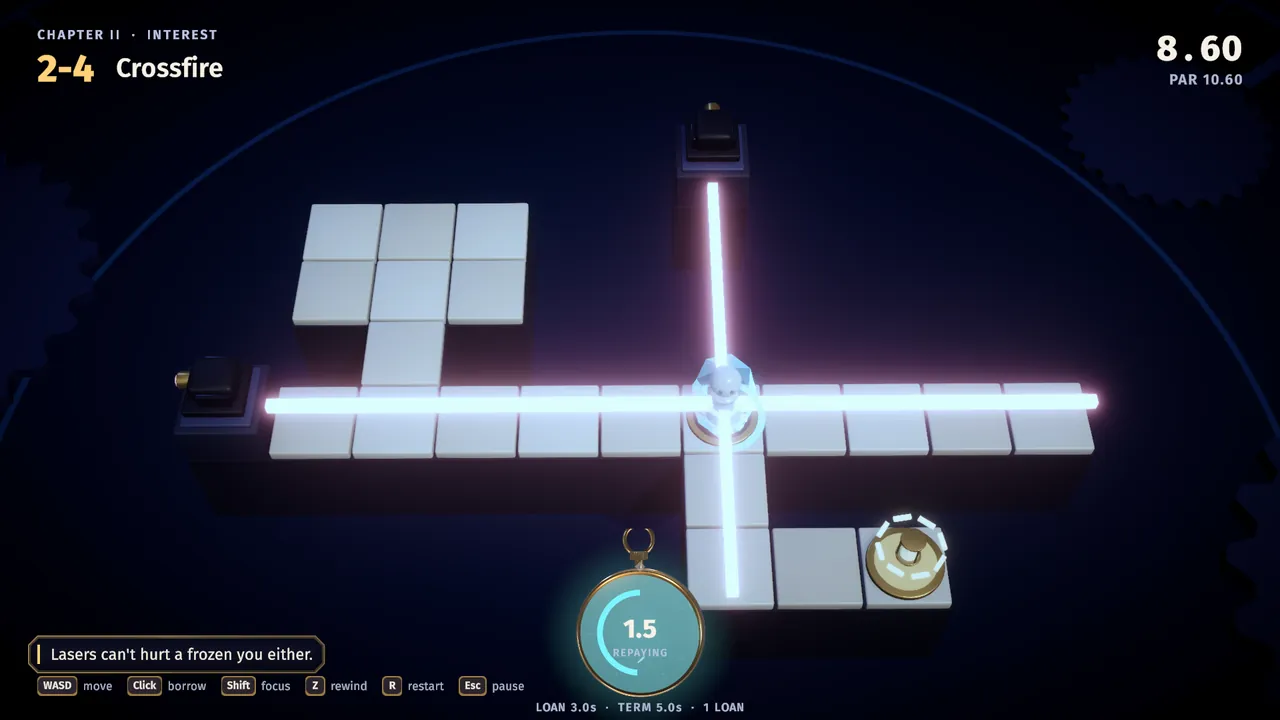
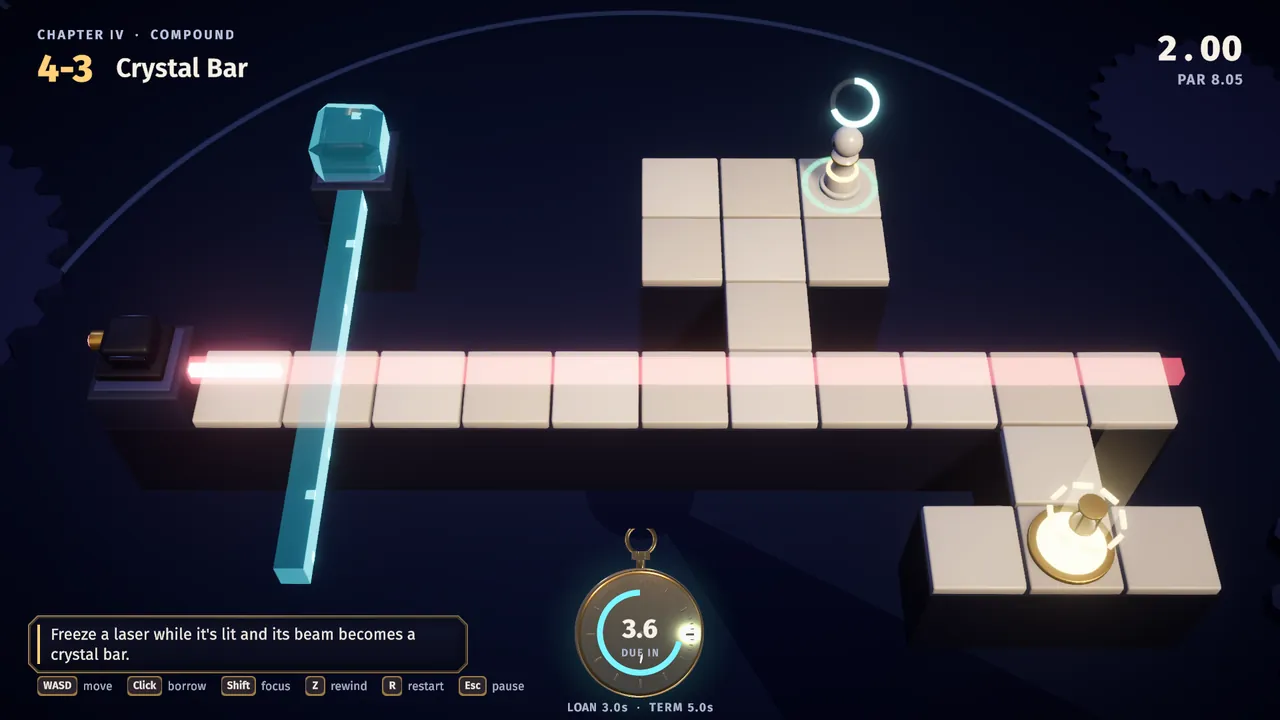
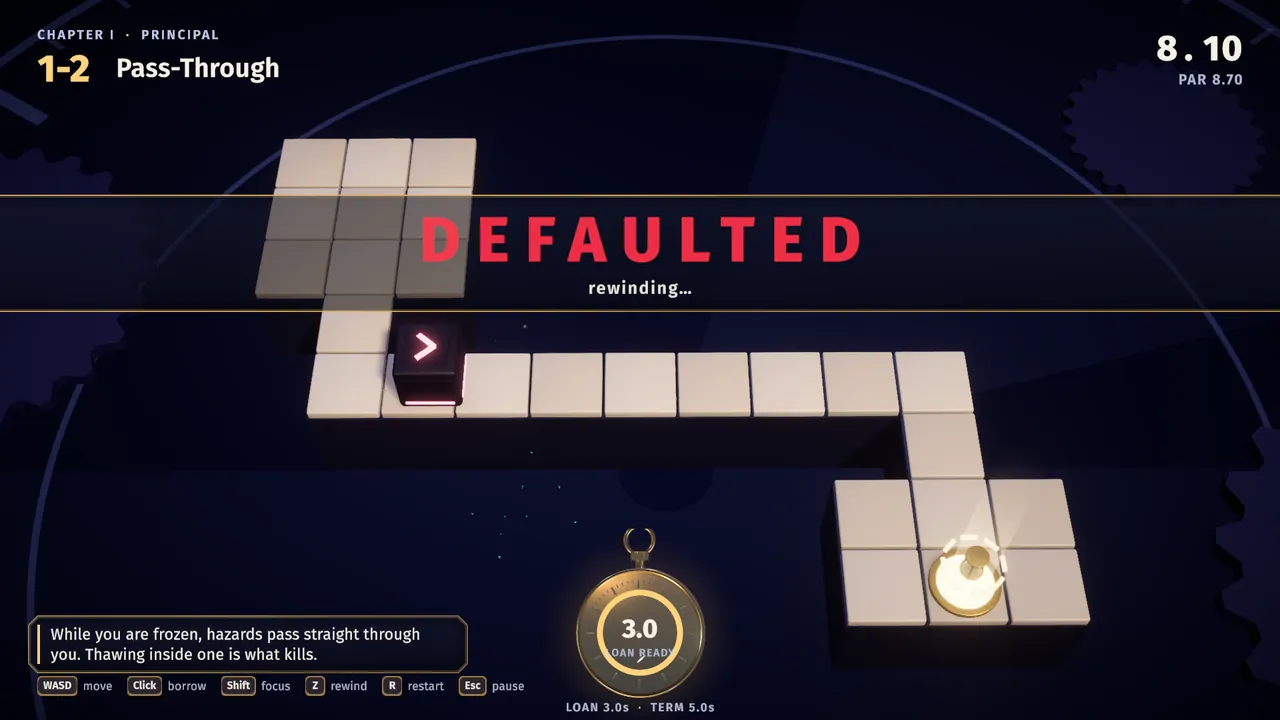
Plates hold a gate open while anything rests on them, including a block you froze there, and each plate wears the same colour and dots as what it controls. Gold dials latch after three seconds of continuous weight from you, frozen or not, or from a frozen block. In later chapters, crystal pushes back: a frozen block pens another slider in, rotor arms swing back off crystal, and a gate you shut blocks light.
Thirty-five levels, proven
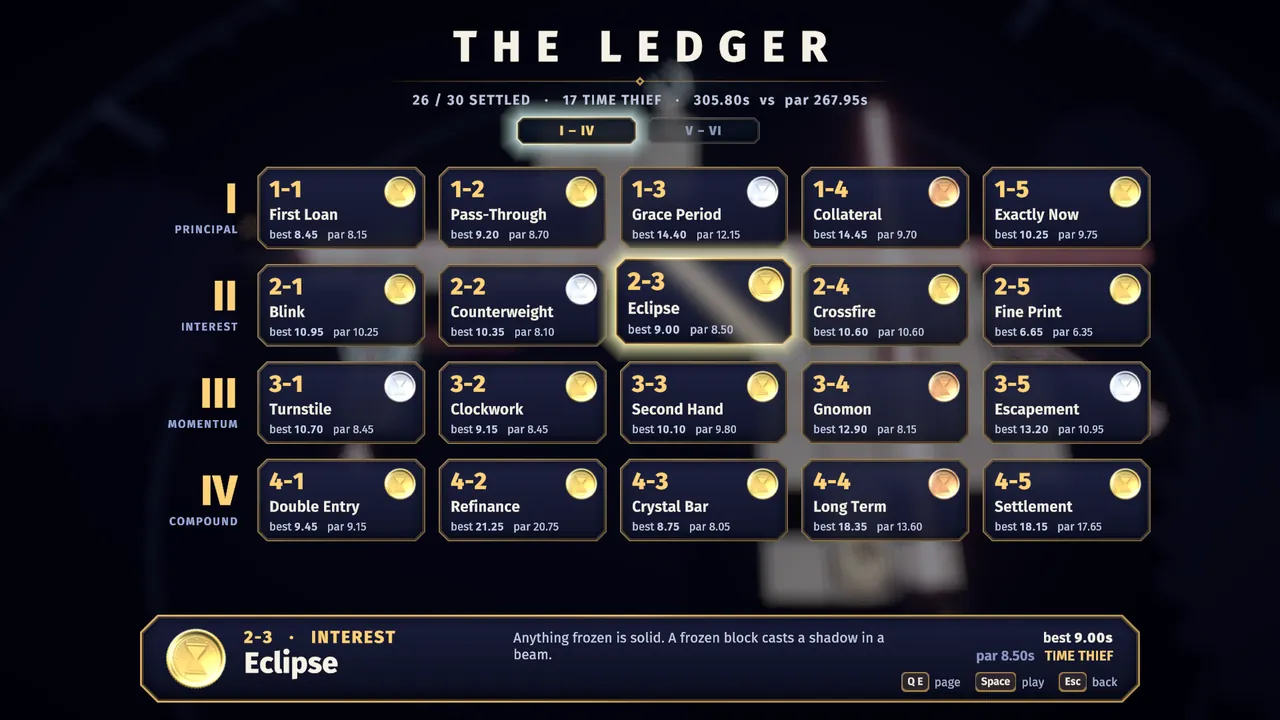
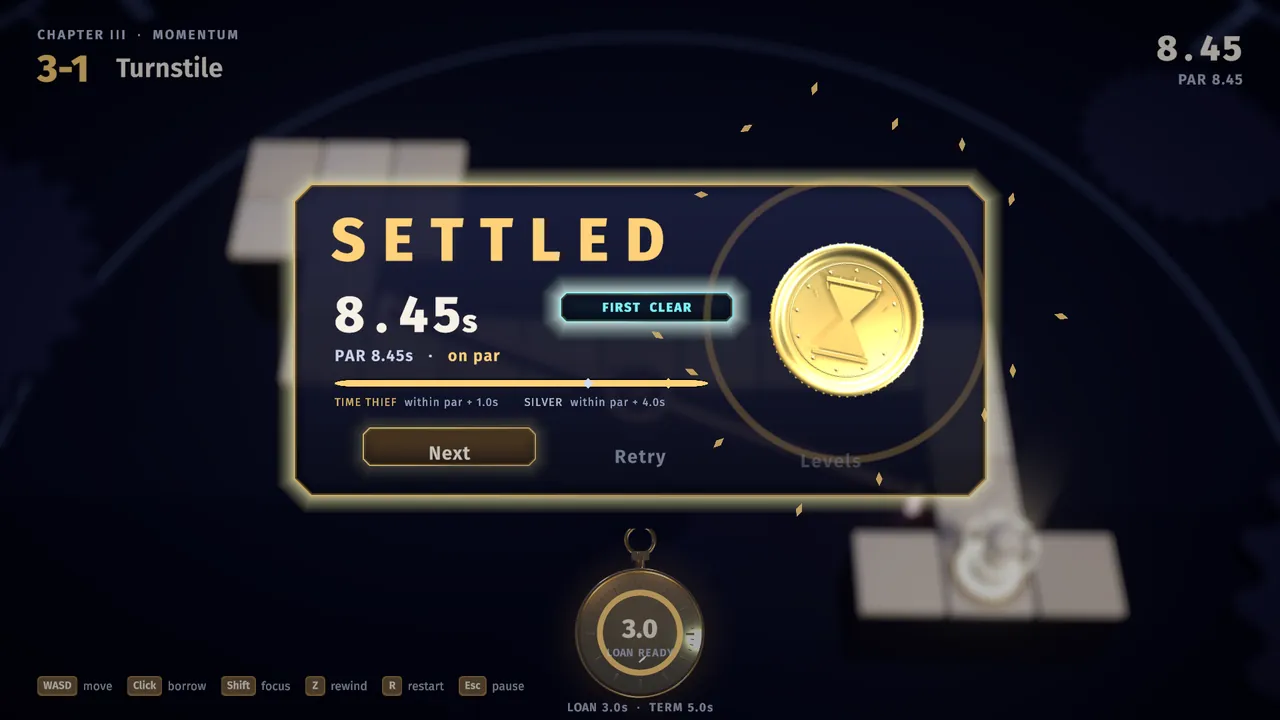
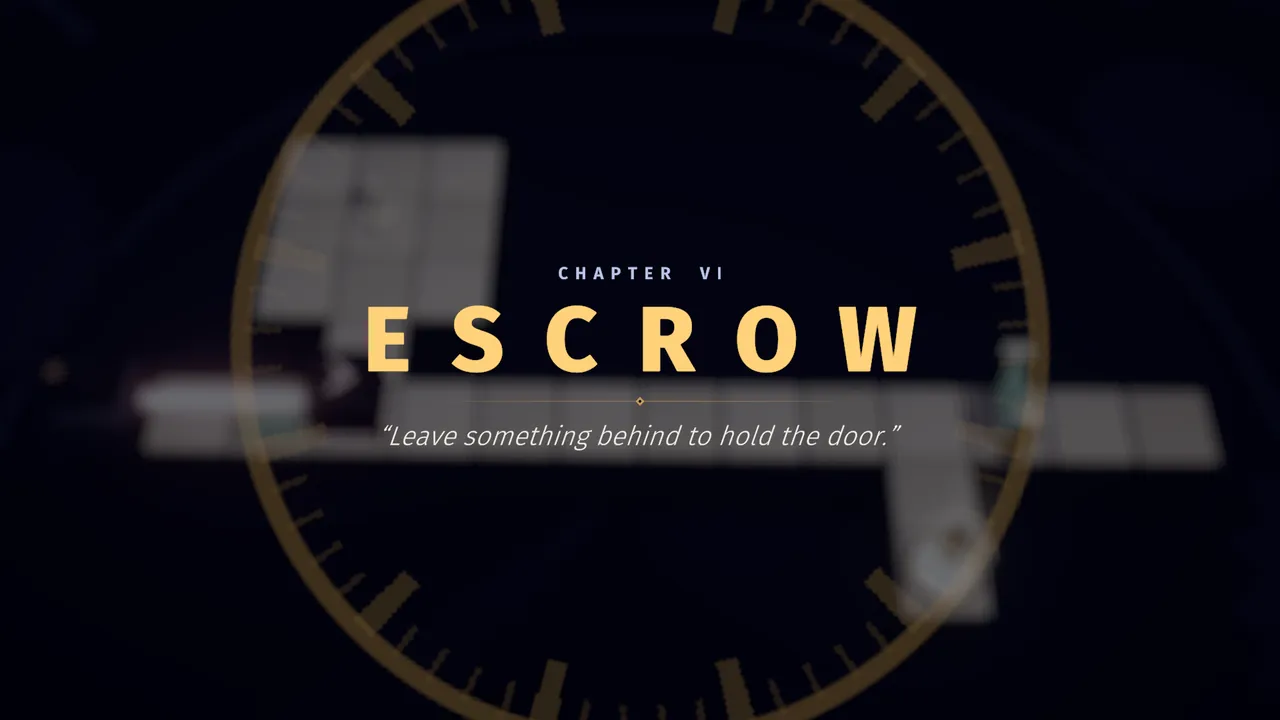
The seven chapters have names borrowed from finance: Principal, Interest, Momentum, Compound, Leverage, Escrow, and Overdraft, where the debt falls due 1.5 to 2.5 seconds after you borrow. Every level is solvable, and that’s been proven. For eighteen of them, the solver also proves you need the debt: even with unlimited, debt-free borrowing they can’t be solved, so your own freeze has to be part of the answer. Every level keeps a timing margin of at least ±150 ms around its intended solution. Par times are the solver’s optimal time, which sets the medals.
On a level you’ve settled, a medal coin by the clock flips from gold to silver to bronze the moment a better medal slips away, and a violet ghost replays your best run in step with the clock. Help comes only if you ask: Show a clue marks the obstacle the solver’s route freezes first and the tile to stand on when the debt falls due, and Watch solution plays the solver’s route at par.
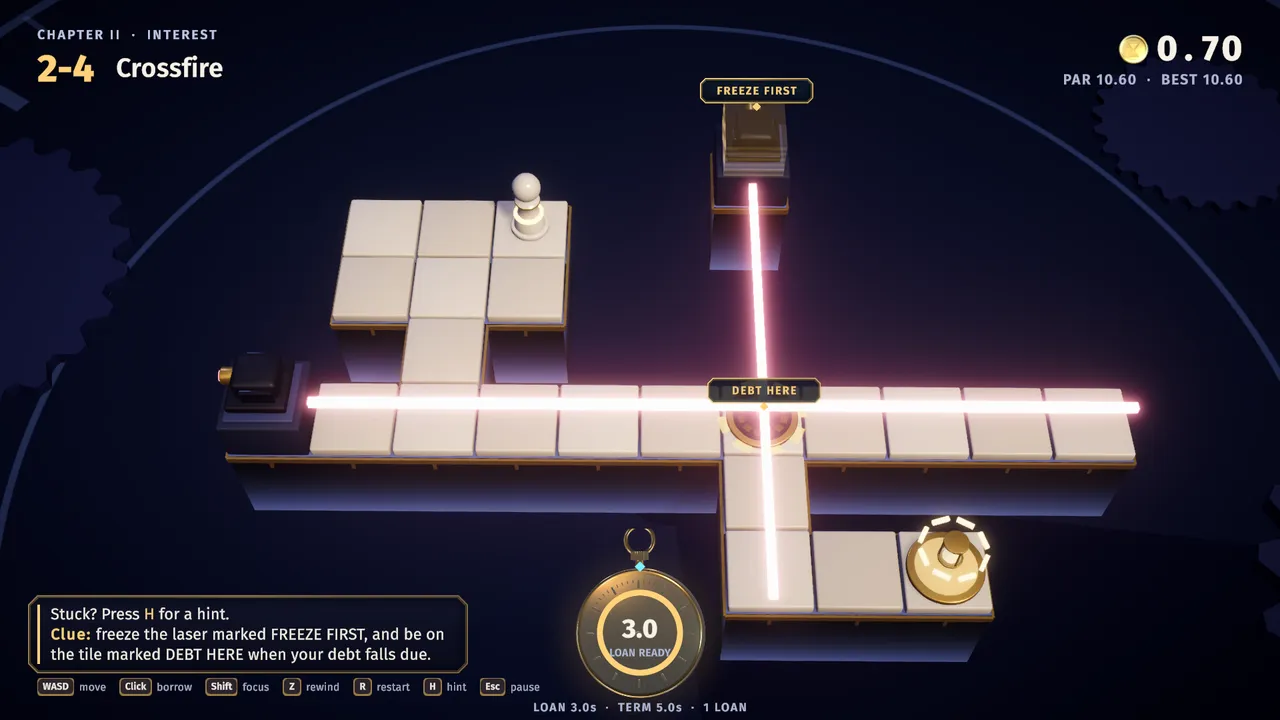
Settings and graphics fidelity
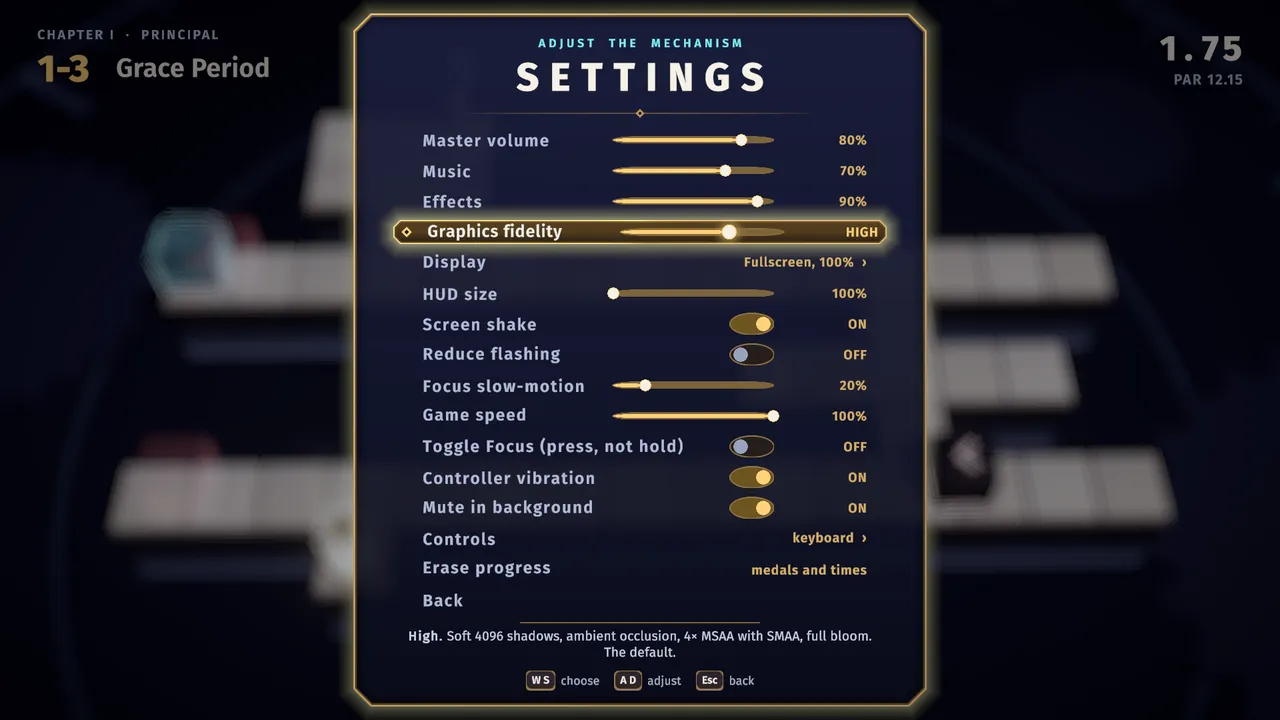
Every row in Settings says what it does in a line under the list. There’s a game speed of 100, 85, 70 or 50% (times and medals count game ticks, so they mean the same at any speed), a HUD size up to 150%, Focus as a toggle, Reduce flashing, screen shake, controller vibration, mute in the background, and a render resolution for weaker GPUs. Every keyboard action can be rebound, menus work with keyboard, mouse or gamepad, and the key hints use PlayStation or Switch names on those controllers.
Graphics fidelity has four steps. High is the default and the original look; Ultra adds 8× MSAA, an 8192 shadow map, deeper ambient occlusion, point lights from the glowing pieces, more particles and a sharper pocket watch. The board itself is finished with brass trim around every outer edge and plinth sides that glow faintly before fading into the void. On the shared integrated Radeon it was measured on, the median frame at 2560×1440 rose from 11.4 ms on Low to 15.0 ms on Ultra.
What it’s built with
The rules are pure C# with no Unity dependency. Simulation.Step advances exactly one 20 Hz tick using only integers, with no allocation and no unordered iteration. The game, the ghost previews, a .NET 8 console solver, and the unit tests all compile the same files, and the tests check that .NET and Unity’s Mono runtime agree tick for tick.
The solver is a breadth-first search over packed 256-bit states at the player’s decision points, with a compact hash table to save memory. It finds the optimal par, then searches again under relaxed rules to prove a level can’t be solved without borrowing, or with the debt forgiven. The hardest level searches up to 150 million states. The clue and Watch solution come straight from its route. Rewind is cheap by comparison: every tick’s state is kept in a pooled history, so rewinding just scrubs backwards through it.
Unity 6 and URP draw the board, with every UI panel rendered by one procedural shader: a chamfered brass rim, enamel gradient, glow, and a clock-hand reveal.
How it was made
Borrowed Seconds was one of eight games built in parallel from short designer briefs, each by its own AI coding-agent session on one shared machine. The brief asked for twenty single-screen levels, one borrowing ability, and three obstacle types, and required a fully deterministic simulation and a solver that proves both solvability and that the “debt as a tool” trick is needed where it’s designed to be. The launch build had thirty levels.
There are no stock assets. Every model is generated by Blender scripts, and every sound effect and the four 16-bar music loops are synthesized with NumPy, with reverb tails wrapped so the loops are seamless.
After launch, the game went through twelve rounds of improvements, each run by a fresh AI session and pushed only after its logs were checked. Those rounds added chapter VII, the start hold, the clue, Watch solution, medal pace, the best-run ghost, rebinding, game speed and the fidelity slider. They found that the borrow prompt never appeared on a controller, and that a few slow frames could turn the 3D view black for the rest of a session. The release build now autoplays all 35 levels at exactly par, 421 EditMode tests replay every solution, and behaviour checks and an input bot run inside a private, invisible KWin desktop.
The trailer is a shot list played by the release build using solver replays, captured frame-locked at 60 fps on Ultra, with the soundtrack rebuilt offline from the game’s audio event log.
On phones and tablets
The browser version’s WebAssembly heap reached 386 MB, which is risky on a phone. About 144 MB of that came from TextMeshPro reading the Fira fonts’ full kerning tables, found by logging Unity’s own memory figures at each step of start-up. The game also rendered at the phone’s full pixel density, three times on an iPhone. On touch devices the fonts now skip kerning, graphics start on Low with the HUD at 150%, and rendering is capped at twice the density and about 1080p. The heap at the title fell from 386 MB to 149 MB, and a tab the browser killed reloads lighter and says why.
The controls are a d-pad (hold to walk), Focus, Borrow, Rewind, Restart, Hint and pause, plus OK and Back in menus. Tapping a piece aims at it, and the aim stays so you can read the forecast. Menu rows, cards and sliders all take taps, and holding the device upright pauses and asks you to turn it. The controls appear only on touch-first devices or after a touch, and desktop browsers keep kerning and the old defaults.

It has only been played in headless test browsers with iPhone, iPad and Android phone profiles so far. A real phone still has to confirm iOS’s memory limit, sound, frame rate, and how the controls feel under a thumb.
Play it
Play it in your browser at nearbycoder.github.io/BorrowedSeconds, on a desktop or on a phone or tablet held sideways. It’s the current game as a WebGL build of about 18 MB, starting on Medium graphics on a desktop and Low on a phone, with saves kept in the browser. The browser skips the low-pass muffle while you’re frozen, because Unity’s web audio has no filters.
Download v0.1.0 from GitHub releases for Linux. That release is the October 4 launch build, with 30 levels in six chapters and none of the improvements above; for the current game on the desktop, build it from source with Unity 6000.6.2f1. It hasn’t been playtested by people yet, so some levels may be harder than they look, and chapters VIII to XII are named but not shipped.
Browse the source on GitHub. GitHub records the repository’s creation on October 4, 2026.