
Elderglen is a 3D action-adventure that plays like the late-90s classics: lock-on sword combat, a context-sensitive action button, a hub field with a day and night cycle, a puzzle dungeon with keys, a mini-boss and a boss, a companion sprite who gives hints, and a pipe whose songs change the world. It’s a vertical slice, from a village to the bottom of the first dungeon, and it plays on Windows, macOS, Linux, Android and in the browser.
It aims to look like that kind of game remade twenty years later: stylized-realistic characters, painterly materials, meadows of wind-blown grass and wildflowers, cloud shadows, height fog and god rays, with songbirds, butterflies, fish and squirrels living in it. Everything is original, and everything is generated by code in the repository. Every model and animation is a Blender script, every texture is made in Python, every note of music and sound effect is rendered or synthesized in Python, and the game itself is Unity 6 with the Universal Render Pipeline.
The slice
Wren, a village kid, is woken by Fen, a lantern-moth sprite sent by the Antlered Warden, the colossal stone stag who keeps the vale. A thorn blight is creeping out of Rootdeep Hollow, the shrine beneath the Warden’s roots.
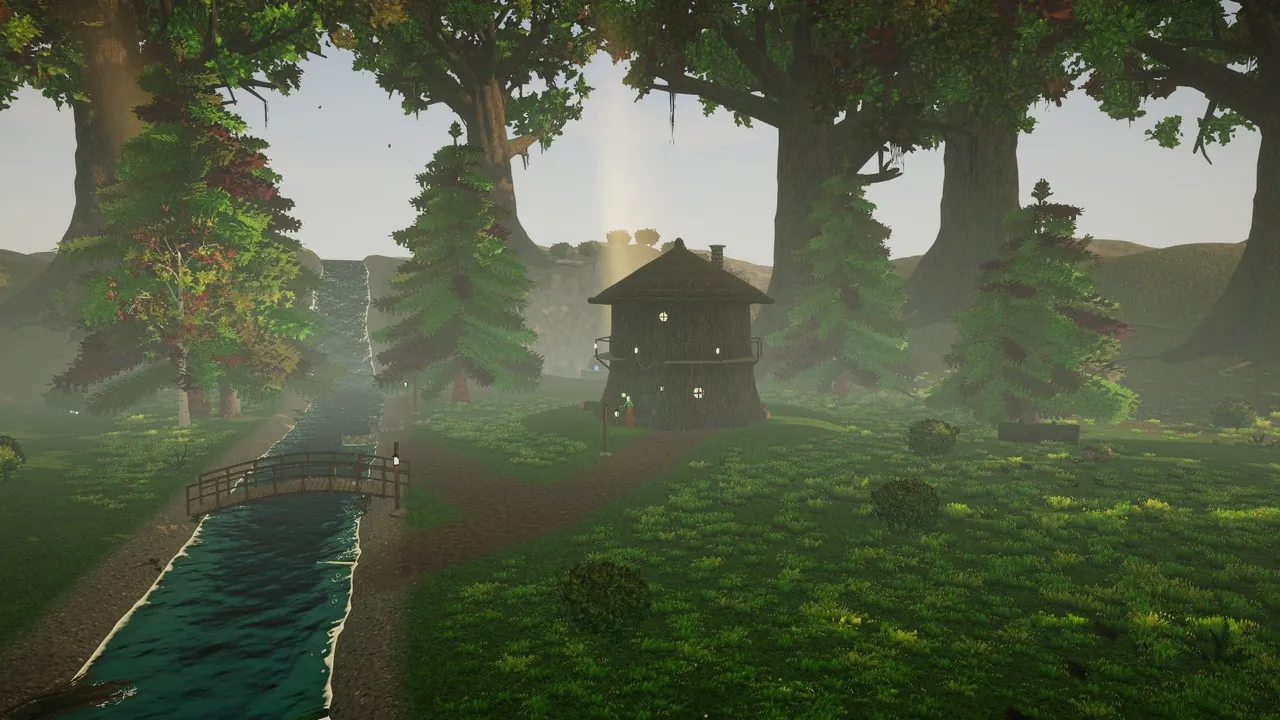
- Mossbrook is a glade ringed by giant trees and split by a brook with a water-wheel. Talk to Elder Ysolde, find the Wayblade in the Training Grove, earn 40 glimmers cutting grass and smashing pots, buy the Bark Shield from Pell, get past Kit at the gate, and receive the Reed Pipe and the Song of Dawn from Tamsin.
- Greenreach is the open field: a river and its stone bridge, ruins with a heart piece up a vine wall, a ring of standing stones, and a lone oak worth rolling into. Day and night pass, twig skeletons rise after dark, and playing the Song of Dawn turns the day.
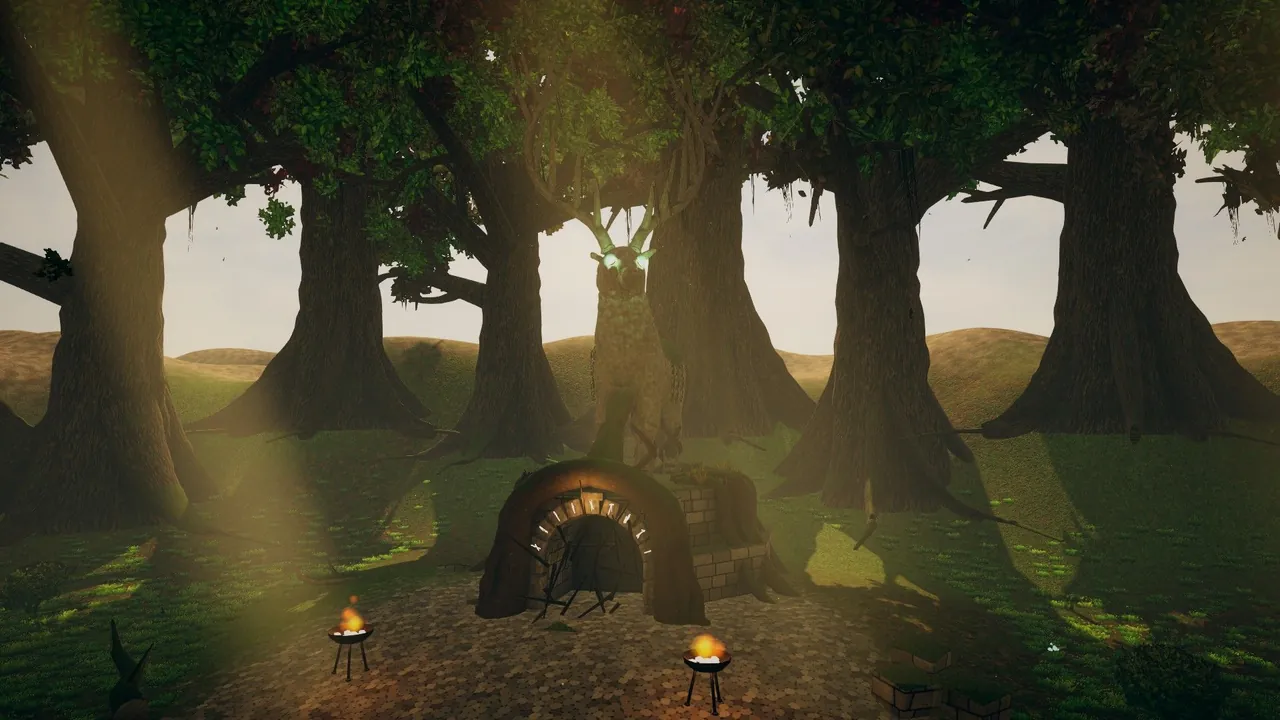
- The Warden’s Grove is misty and sacred. The Warden speaks, and you carry fire from a brazier on an Ember Branch to burn away the thorns that seal the way down.
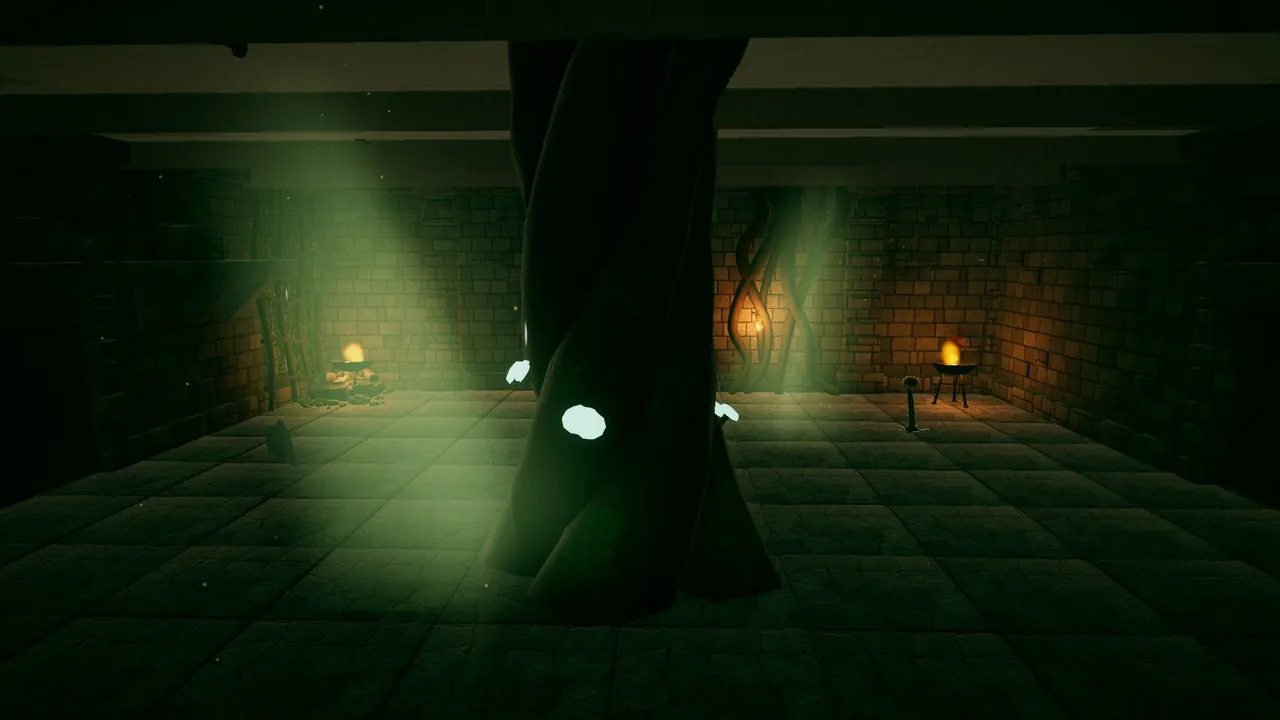
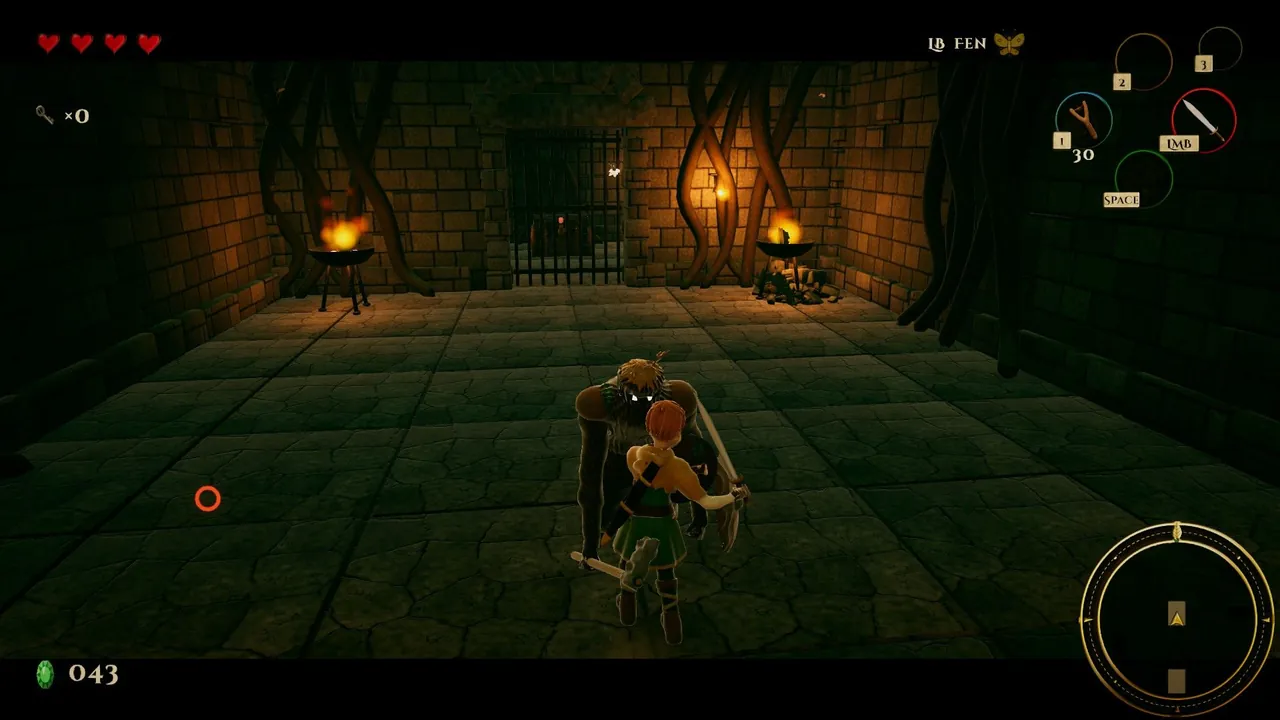
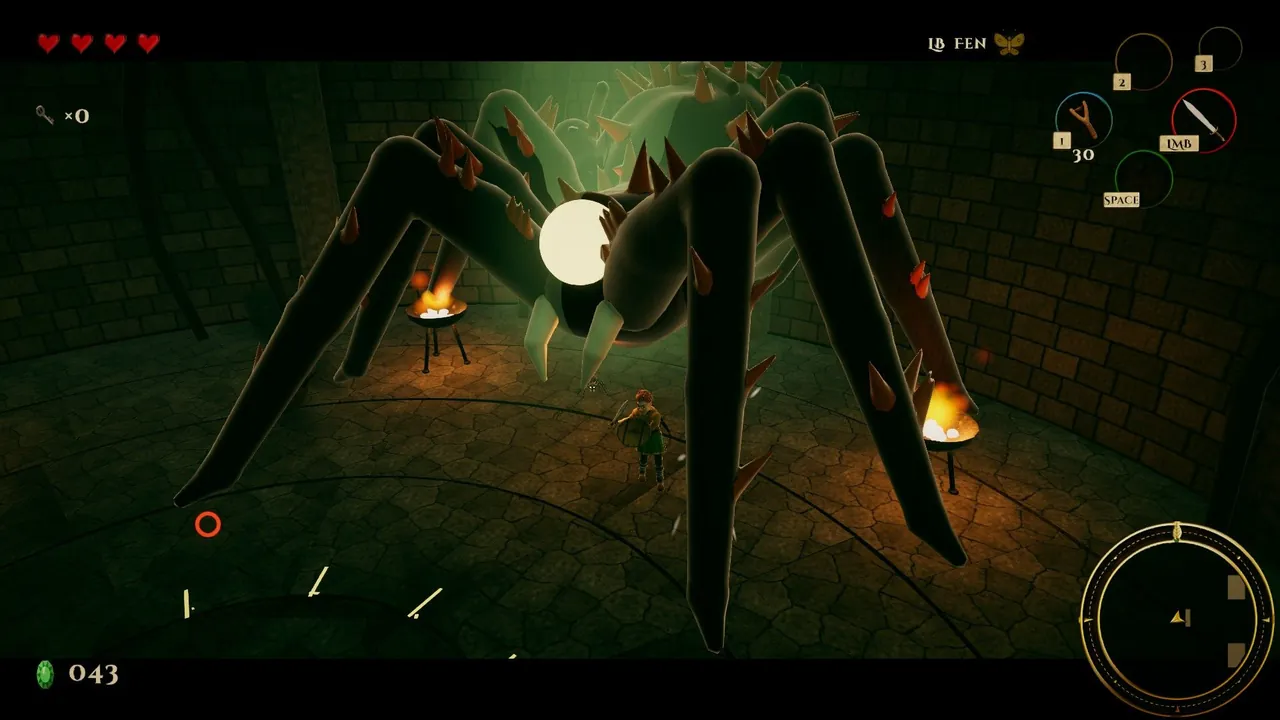
- Rootdeep Hollow is the dungeon. Push a block onto a switch, carry flame between braziers against the clock, open doors with small keys, duel the Barkknight for the Seed Sling, shoot eye switches, raise a root bridge over a chasm, and drop into the lair of Gorrath, the Thornmother. Stun her eye with the sling, then strike.
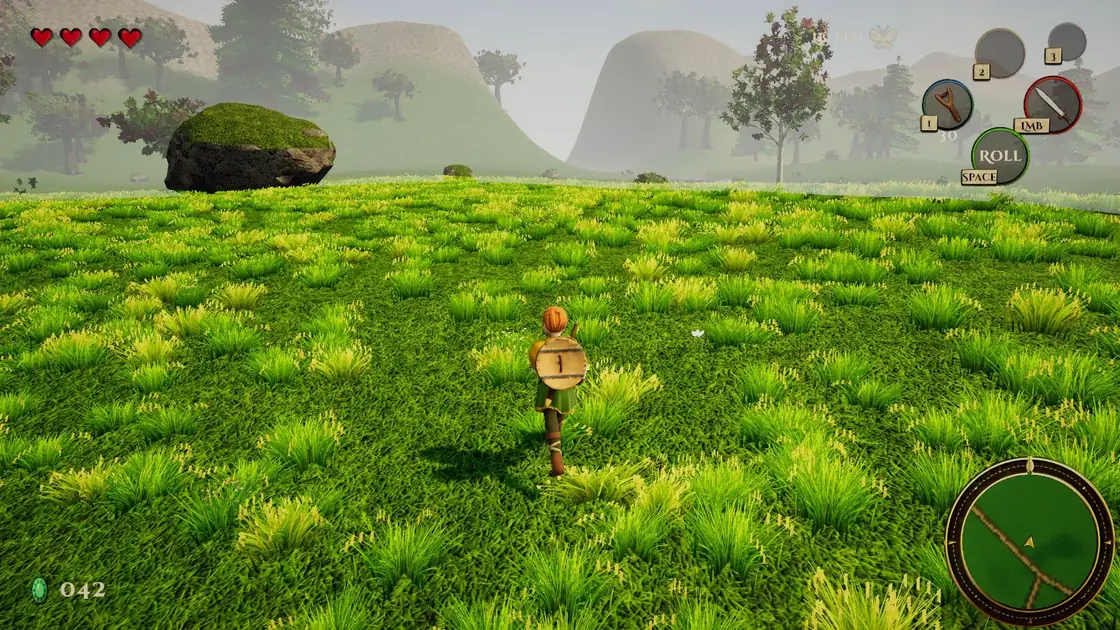
Wren starts with three hearts. Four pieces of heart are hidden in the slice (up the village lookout, on top of the ruin tower, at the standing stones, and on a vine-reached ledge in Rootdeep), and together they make a fourth heart; Gorrath leaves a heart container. There’s a dungeon map and compass, a minimap, a save file, and an autosave on every area change. After the boss, the Warden has words for you and a second song, the Warden’s Lullaby.
Sword, shield and pipe
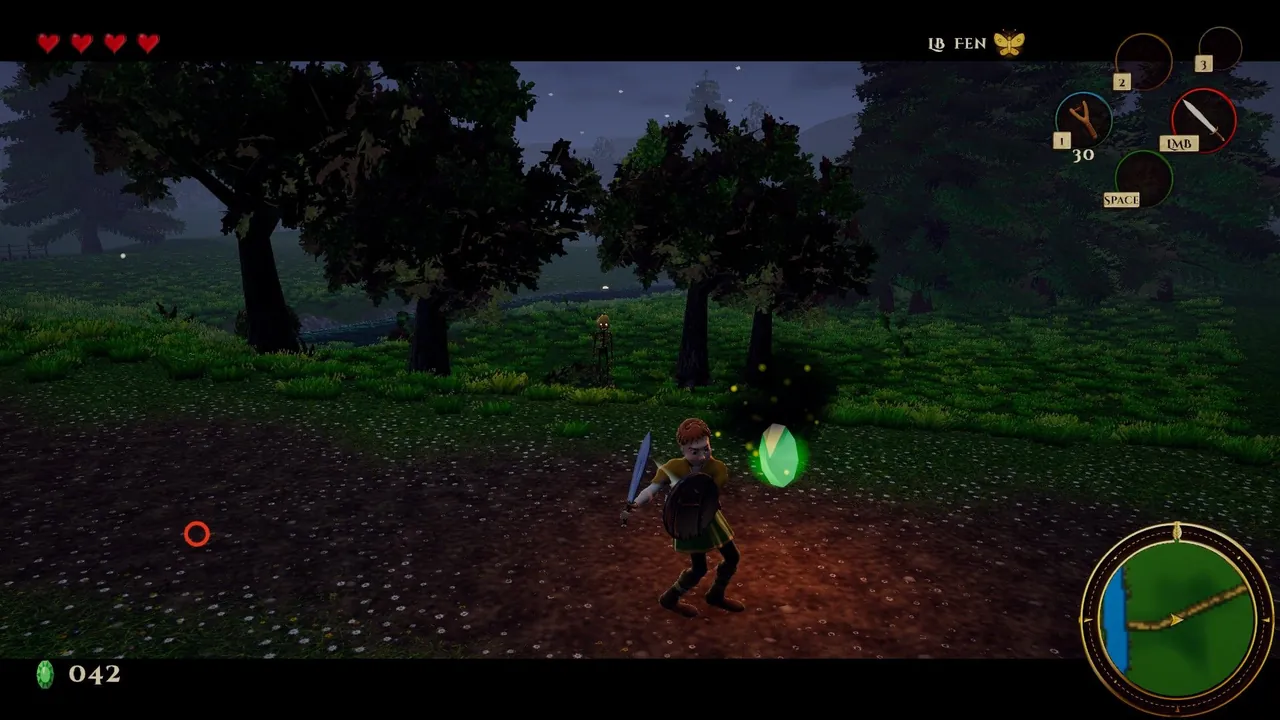
Elderglen is built for a controller first, with keyboard and mouse and on-screen touch controls too. Hold the left trigger to lock on, and the camera adds letterbox bars. While locked on, the stick with A side-hops or back-flips, A on its own is a jump attack, and forward with B is a thrust. B swings the sword in combos, and holding and releasing it does a spin attack. The right trigger raises the shield, which can send a Podspitter’s seed back at it. A is the context action the HUD names: talk, open, roll, climb or jump. Running off a ledge leaps across, walking into a low ledge climbs it, and leaning on a block pushes it. LB asks Fen for a hint.
The Reed Pipe has five notes, played with A and the d-pad (or Space and the arrow keys). Songs are short note sequences, and the slice teaches two.
Made entirely from code
The repository holds more than 200 generated FBX models and 195 audio files, and none of them were made by hand.
- Characters and animation. Characters are built in Blender 4.5 from signed distance fields, turned into a mesh by a NumPy surface-nets polygonizer that runs inside Blender’s own Python, then decimated, UV-packed and baked into texture atlases. Poses are written as bone-local angles, so the 44 hero clips (locomotion with IK feet, sword combos, climbing, playing the pipe) transfer between humanoids; the Twigling and the Barkknight reuse the hero’s skeleton. Creatures from Gorrath to the trout, songbirds, squirrels and a grazing doe have their own rigs and gaits.
- The environment. One Blender generator per category builds the trees, rocks, village, the Warden, the field, the dungeon kit on a 4-meter grid, and the far mountains, with UVs in meters, moss on up-facing faces, and ambient occlusion and wind weights baked into vertex colors. Trees get crossed-card impostors baked from their own full-detail models. Terrain, surface and foliage textures, and the leather, parchment and brass of the menus, are drawn by NumPy scripts. Every generator seeds its random numbers, so a rebuild gives identical output.
- Music and sound. Each of the nine looping themes is a Python function that writes melodies over chord charts and generates the string, harp, bass and percussion parts from them. Every part becomes its own MIDI file, rendered by FluidSynth with the MuseScore_General soundfont, then mixed in Python with a convolution reverb, mastered to -16 LUFS, and wrapped so the loop has no seam. Sound effects, ambience, the Reed Pipe and the villagers’ wordless babble are synthesized with NumPy and SciPy, and a check script measures every file for loudness, clipping, clicks and loop seams.

Tools/audio/gen_music.py.The game itself is C# on Unity 6000.6 with URP 17.6 and the Input System. The project’s one scene is empty: code assembles each area at runtime, from its height-field terrain to the kit pieces placed by id, the puzzles, the encounters and the wildlife. The shaders are custom URP shaders written in HLSL: a lit shader with wind, rim light and a dissolve, plus terrain, instanced grass, water, sky, a fog pass and a hazy mountain horizon. Graphics has four quality tiers: Low and Medium for phones and tablets, with lighter shadows, less grass and a lower render scale, and High and Ultra for desktops, with up to 4K shadow maps, MSAA, dense grass and SSAO. The default is picked from the device.
How it was made
The repository’s twenty commits are all dated November 3, 2026. They run from a Unity 6 scaffold and a design document to v0.1.0, the first playable slice, and then v0.2.0 less than two hours later. That second release, the beauty pass, added the wildlife, the painted meadows, the mountain horizon, drifting cloud shadows, the dungeon dressing and the painted interface. Every commit after the first is co-authored by Claude.
The Linux build has a capture mode that plays scripted tours without a display. The full playthrough tour plays the whole slice through its real mechanics, from dialogue and the shop to Gorrath and the ending, and logs 44 pass or fail checks. Other tours cover the menus and saving, combat against every enemy, character close-ups and frame rate at each quality tier. The beauty pass commit records all 44 playthrough checks, 5 combat checks and 4 menu checks passing. The trailer is another tour: it records frames at a locked 30 fps, logs any frame whose camera sits inside geometry, and FFmpeg encodes the frames over the title theme.
Play it
Play it in your browser at nearbycoder.github.io/elderglen/play. It’s a WebGL 2 build, about 210 MB on the first visit and cached afterwards, and it’s meant for desktop Chrome, Edge or Firefox. The browser version runs at the Medium tier and leaves out the instanced grass. Click the game to capture the mouse; a controller works too.
Download v0.2.0 from GitHub releases for Windows (64-bit), macOS (a universal build for Apple silicon and Intel), Linux (x86_64, Vulkan with an OpenGL fallback) or Android (an ARM64 APK to sideload, with touch controls or a controller). The Mac build is unsigned, so right-click it and choose Open the first time. There’s no iOS download: the project builds an Xcode project that you sign with your own team. Building from source needs Unity 6000.6.2f1, plus Blender 4.5 and Python only to regenerate the art and audio.
Browse the source on GitHub. The creation date shown here is the GitHub repository’s UTC creation date. The screenshots and the trailer come from the repository’s docs/media folder, and the code excerpt is from Tools/audio/gen_music.py.